

 0
0Ericsson
GH 337
Announced
July 1994
Weight
193 grams
Codename
Jane
Features
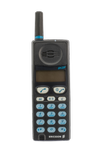
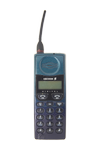
The Ericsson GH 337 was unveiled at the Personal Communications show in London in late 1994. It was the 2G (GSM) version of its analogue (1G) predecessor, the EH 237.
The device was built on Ericsson’s "Jane" platform, a design language that focused on what it described as “professional, understated elegance”. Its build quality was legendary; the internal chassis featured a magnesium-alloy frame that provided structural rigidity while keeping the weight under 200 grams—a major achievement for the era. This durability, combined with its compact dimensions, made it a highly desired device, particularly for business professionals. It was marketed with the slogan "The ultimate business tool".
The GH 337 featured a monochrome LCD screen that displayed three lines of text and a row of dedicated icons for signal strength and battery life. It had a distinctive, stubby fixed antenna and a high-quality keypad with a tactile, clicky response that became a hallmark of Ericsson devices. It could receive but not send SMS text messages.
It went on to win an iF Product Design Award in 1995 and a Red Dot Design Award.
A little-known fact about this handset is that it was the first phone to use an innovation patented by Ericsson’s Mats Barvasten, enabling an automatic key lock, a feature that is still used on modern smartphones.
Mats pushed the entire team hard throughout the phone’s development, and a good example of this was the phone's weight. As the launch date approached and the phone still weighed 200 grams, he was determined to reduce its weight as much as possible to ensure it was lighter than competitive products. To incentivise the team, he committed to buying one bottle of champagne for each gram that was saved. In the end, the phone shipped at just 193 grams, costing Mats seven bottles of champagne but beating the competition. This was a great achievement by the team led by Jan Svensson and a testament to their brilliant engineering.
The code name Jane was inspired by the English actress Jane Seymour.
The phone was manufactured in Sweden at its Kumla factory.